
Sunday, May 12, 2013

A Spring Fling

In just a few short weeks fifth graders in U. City will walk through the doors of their elementary schools as students for the last time. When the school year begins in the fall they will be middle school students at Brittany Woods.

This is a bittersweet moment for parents, but an exciting time for those pre-teens. As I overheard my daughter say to her girlfriend, "I can't wait for sixth grade. I am sooo over fifth grade."

In the spirit of celebrating their elementary years and their promotion to middle school, Jackson Park hosted its first ever "Spring Fling" for the fifth grade class.

Fifth graders that attended the Spring Fling

Students arrived in festive attire (some which had been planning what to wear for weeks). One young gentleman arrived with flowers in hand for his favorite girl and the crowd erupted in screams of excitement.

 
All you can eat pizza, nachos, and sno cones and special cupcakes kept the group energized during the party.


In between snacking there were congo dances, line dances, limbo dancing, hula hooping, and even some break dancing face offs.


Dancing the night away!

Thank you to Bella Quintal and Stacie Foote for organizing the event. In the words of those that attended, it was "the best party ever!"

Bella Quintal and Stacie Foote

Girls on the Run

Yesterday morning our family rose at 5 a.m. to journey downtown and cheer on our "girl" while she ran a 5k with her Jackson Park Girls on the Run team and 8,000 other people.

Getting ready for the practice 5k on the high school track.

Girls on the Run St Louis is a non-profit prevention program that encourages preteen girls to develop self-respect and healthy lifestyles through running.

The 20-lesson Girls on the Run curriculum combines training for a 5k (3.1 miles) running event with lessons that inspire girls to become independent thinkers, enhance their problem solving skills and make healthy decisions.  All of this is accomplished through an active collaboration with girls and their parents, schools, volunteers, staff and the community.

Head Coach Nancy Mozier

At Jackson Park we are fortunate to have Nancy Mozier and Peggy Stein as the teacher coaches and Vanessa Schrader and Amanda Elliott as our volunteer coaches. To their credit, there were a number of other teachers that assisted along the way.

JP "vogues" as they get ready to race.
 
Over ten weeks the girls improved their teamwork, respect for one another and self-esteem. I especially loved the day my daughter came home and told me how she and another girl had become friends through GOTR when previously they thought they had reasons to dislike one another.
 
But race day isn't just for the girls - it's a family affair. Mothers, brothers, dads, sisters, aunts, and uncles and grandparents too, all converge on downtown St. Louis to run, watch, and cheer on the runners to the finish line.
Brothers running to support their sisters, while others prefer to cheer on the runners...
 
 
What a sense of accomplishment for these girls to finish a 5k race with the excitement of 8,000 other runners. Our girl is moving to middle school next year. While she may miss some of her GOTR JP teammates, she'll be joining others at Girls on Track at Brittany Woods Middle School.
 
A well-earned rest after the race.


Friday, May 10, 2013

Tuba Time!

Let's just say it, the tuba isn't the most flashy instrument in the band. But when UCHS tuba players perform, Joshua Standifer, a freshman and William Mitchell, a senior, sure make it look fun.

Joshua Standifer (left) and William Mitchell (right) with
master tuba teacher Carol Jantsch
At the encouragement of Roger Davenport (U. City resident and former member of the St. Louis Symphony), Joshua and William participated in a master tuba class with Carol Jantsch as part of the St. Louis Low Brass Collective.

Just another one of the great opportunities afforded our students at UCHS by the generosity of our community volunteers.

There is a band concert at UCHS tonight (Friday, May 10 at 7 p.m. in the UCHS auditorium) and I'll be listening close to those fine tuba players.


U. City Grad in Wash U News

UCHS Grad, Justin Nicks, is featured on the Wash U web site.

“Some people have a hard time believing that even a smaller gift has an impact,”
says Olin senior Justin Nicks, “but it absolutely does!”
Through Senior Class Gift, St. Louis native Justin Nicks (BSBA’13) continues his family’s tradition of philanthropy            

How old were you the first time you donated to an organization?
My dad’s a Baptist minister, and I learned early on the importance of giving ten percent to help benefit the community. At the age of ten, when I earned my first paycheck mowing lawns, I donated.
You’re both a donor to and a fundraiser for the Senior Class Gift initiative.  How did you get into raising money for the university?A couple of years ago, some other students and I did a fundraiser in honor of the late Dean [James] McLeod. We sold cookies to help fund the relay team. It felt great to pitch in and see that immediate impact.

Why should students give to Wash U?
Tuition covers only 60% of the cost to educate students on the Danforth Campus—that seems to sink in when we tell fellow students. I’ll say, “Picture your classroom. A significant number of your classmates receive some form of financial aid. Imagine if 40% of them were just gone. If it weren’t for donors giving back, we’d have a lot less opportunity to learn and grow.”

 
Where did your Senior Class Gift go?
Half of my gift went to Olin, and half went to the engineering school (I started off there as a freshman, then transferred).


When you picture the impact of your giving, what comes to mind?
I picture another student going to class, facing the same struggles that most students face, maybe not knowing that some of their financial aid might have come from students and alumni. But it’s fine with me if they don’t know it’s my money that helped—as long as it’s helping. I’m just glad they’re here.

Tuesday, May 7, 2013

Zach Morrow Named a Jazz St. Louis All-Star

University City High School's own Zach Morrow has been named one of the 2012-2013 members of the Jazz St. Louis All-Stars–the top students in the JazzU program!

Zachery Morrow

Zach is also a member of the UCHS marching band and has won numerous honors for his percussion skills. His bio for the Jazz St. Louis web site reads:

Zachary Morrow (drums) is a Senior at University City High School, which boasts the likes of Peter Martin and Jeremy Davenport as alumni.

This is Zachary’s third year in JazzU and his first as a member of the Jazz St. Louis All-Stars. Having studied the drums for 15 years, he is already well ingrained in the St. Louis music scene, performing in the University City High School jazz and marching bands, the Sean Holland Band, Jazz in Outer Space, and at his local church.

An honor roll student since sixth grade, Zachary has received numerous awards, including an Outstanding Musicianship award from the Greater St. Louis Jazz Festival (2011) and the University of Missouri – Kansas City (2010-2012). Most recently, he was selected as the drummer for the 2012 All-Suburban High School honor jazz band.

“The most impactful thing about JazzU,” said Zachary, “is getting to work with great jazz legends Cyrus Chestnut, Peter Martin and Tim Warfield. Not to mention the chance to play with fellow musicians who share the same passion for music as I do, and the opportunity to express myself through my music.” He lists Art Blakey, Buddy Rich, Dennis Chambers and Dave Weckl among his many musical influences.

For bios on the other Jazz St. Louis All-Stars visit Jazz St. Louis.

Monday, May 6, 2013

JP Fourth Grader Overcomes Barriers and Inspires Others

Xavier at Busch Stadium with Sharon Robinson

Jackson Park fourth grade Xavier Morgan-Gillard has made quite a splash in local media this past week, and with good reason.  Xavier was selected as a first-place winner  of the  Major League Baseball/Scholastic Books Jackie Robinson Breaking Barriers essay contest. 

Selected from a field of 18,700 submissions, Xavier’s essay, “What Jackie Robinson and I Have in Common”, tells about his struggles in overcoming Selective Mutism, a severe social anxiety that left him unable to speak to people outside his own family.
 
Xavier’s father Tim first learned of the honor last Friday when Major League Baseball called him at work - an experience he described as “awesome.”  That phone call kicked off a whirlwind of events celebrating Xavier’s accomplishment, as well as the legacy of baseball legend and civil rights champion Jackie Robinson. 

On Tuesday, Robinson’s daughter Sharon was at Jackson Park (along with Fredbird!) to present the award in front of classmates and administrators.  The event was covered by KSDK.  Then, on Tuesday night, Xavier and his family were special guests on the field at Busch Stadium, where Xavier was honored once again.  On Thursday, there were nice articles in both the Beacon and the Post-Dispatch.
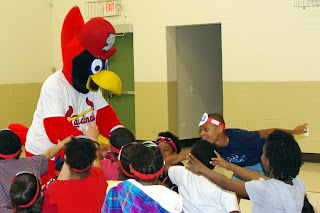
Fredbird greets the kids at JP
Xavier (2nd from left) and JP Friends

Getting autographs at the ballgame
As exciting as the week’s events have been, the real inspiration here is Xavier’s story.  Like Jackie Robinson, Xavier faced circumstances which left him feeling isolated and unable to achieve his full potential. With great determination, confidence, and a special friend (as well as lots of support from parents and teachers) Xavier overcame his own barriers has gone on to inspire others.  Here’s his story, in his own words:   

WHAT JACKIE ROBINSON AND I HAVE IN COMMON
BY: XAVIER MORGAN-GILLARD
The barrier I overcame was Selective Mutism. When you have Selective Mutism, you are afraid to talk.  I couldn’t talk to anyone other than my family.  I didn’t speak at all in school until the second to last week of first grade.  My kindergarten teacher never heard me speak except videos of me talking at home that I showed her after school sometimes. People thought I was just “shy,” but it was more than that.  My parents told me that Selective Mutism is a type of social anxiety, and that when they first took me to a psychologist for help, the psychologist said SM is one of the hardest anxiety disorders to get past and takes a long time.
I felt like I was in my own world and no one knew what I was thinking, except my parents, my brother, and my friend, Adam. I remember feeling really nervous the first day of preschool.  I remember looking around and everyone was talking and having fun and I was just staring at the wall.  I knew that most people could just talk whenever they feel like it. I felt a little bit jealous. I remember feeling almost like an alien. I thought people would make fun of my voice. I was worried in school because usually I didn’t sit by Adam so I couldn’t whisper, “Hey, can you get the teacher? I need something.”
If you had met me back then, you wouldn’t have said, “Xavier, you remind me of Jackie Robinson!” Even if you had said that to me, I would’ve thought, “Who’s Jackie Robinson?” Since then, I’ve learned a lot about him (through books and a play) and it seems like we overcame barriers in a similar way, using similar values.
Jackie Robinson and I both had confidence. He had confidence to be the first black man ever to play professional baseball with a lot of white people. Without confidence, I couldn’t have learned to speak to new people or even to my teachers. I was brave by going into a classroom with kids who were comfortable talking, yet I couldn’t. Jackie Robinson must’ve felt very different, like I did. He probably felt nervous and excited thinking, “Look, I’m making the history books!”  When I started talking, I didn’t feel like I made the history books because I didn’t!
Getting past Selective Mutism took a lot of determination. I had to stay focused on being able to talk to other people instead of saying to myself, “I give up, I don’t want to talk.” Sometimes, my family and I went to Steak and Shake where I was determined to order my own milkshake so I could have a treat. This was very hard for me, but once I did it a few times, it got
easier.  I worked on overcoming SM by doing things like that every day for four years.  Like Jackie Robinson, I had to have commitment to succeed.
Out of all the traits that Jackie and I have in common, I think that teamwork was the most important one. My team was me, my parents, Ms. Hendrix and Ms. Stuart (my kindergarten and first grade teachers), Dr. Pingel (she’s a psychologist), my friend, Adam, and a horse named Cappy. I had to tell Cappy to “Walk On”, “Trot”, and “Whoa”. It helped to start talking to someone who I was sure wouldn’t tease me. But, the most helpful teammate of all was my friend, Adam. In school I’d whisper answers in Adam’s ear and he would repeat what I said to the whole class.  This really helped me a ton. Jackie Robinson needed teammates to accept him for who he was like Adam did for me.
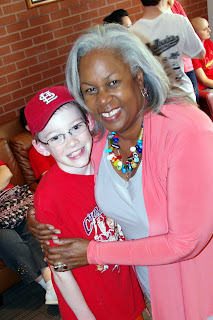
Xavier's friend Adam, with Sharon Robinson
Now, I’m in fourth grade and I still use the values that Jackie Robinson and I share when I want to be successful. I am in the student council, on a robotics team, play soccer, baseball, piano, and cello. When something is hard for me, I think about Jackie Robinson and how he overcame his barriers, which helps me overcome mine. Now if someone said, “Xavier, you remind me of Jackie Robinson!” I would say (yes, say), “You’re right!”

Sunday, May 5, 2013

Holocaust Survivor Speaks to U. City Students

April 8 was Holocaust Remembrance Day. That seems to be lost on some in other parts of the country. A mom in Michigan thinks “The Diary of Anne Frank” is too “pornographic” for middle school reading. While in Albany, New York a teacher is being disciplined for assigning a Nazi propaganda essay on why Jews were evil.

Reading stories like these in the news make me glad to live in U. City where diversity and knowledge are celebrated. 

Instead of controversy, our students heard a remarkable, first-hand account of the holocaust from Sara Moses, one of the youngest children to survive a Jewish ghetto in Poland and two Nazi concentration camps.  Ms. Moses barely survived the concentration camp and was eventually reunited with her father and they immigrated to St. Louis.

On April 12, Ms. Moses shared her story with classes at the middle and high schools.


Sara Moses visited with Brittany Woods Middle School students
and shared about her childhood
experiences in a World War II
concentration camp.
My seventh grader was privileged to hear Ms. Moses speak. In his words, it was “life-changing” to hear her story. Until meeting Ms. Moses he had only read about the holocaust in books. Hearing her speak brought history to life and have him greater empathy for those that suffered like Ms. Moses. He also said it gave him a better understanding of the cruelty that took place and emphasized the importance of being kind to people.
 

Holocaust survivor Sara Moses spoke with University City High
School students in Eleanor Aboussie and Michael Daly's classes.

 
How fortunate our students are to have such rich experiences as part of their academic studies.
 
Below is a story from the Idaho Mountain Express which tells some of Sara Moses' story.

 
Holocaust survivor tells her story
Imagination and extra food from a Nazi guard kept Sara Moses alive


Wednesday, October 12, 2011

By TERRY SMITH
Express Staff Writer


Sara Moses says she survived Nazi concentration camps by using her vivid imagination and because of the generosity of a female Nazi guard.

Now 73, Moses was a 6-year-old Jewish girl when she was separated from her family and taken from her home in Poland in 1944.

"Out of necessity, I developed a rich, strong, imaginary world that helped me to survive the horrors that were to come," Moses said Friday at the Community School in Sun Valley. "I used what I had. I had my hands. I imagined that the fingers on my hand had faces. I gave each one of them names. My fingers became my family."

Moses is one of few children who survived the horrors of the concentration camps.

Moses now speaks throughout the United States about the Holocaust. She said she is willing to revisit the horrors of her childhood because "evil-doers grow bigger and stronger when they are surrounded by people who say nothing."

"The reason I speak, why I go back to those times is so that lessons of the Holocaust, not just the Holocaust, but the lessons of the most horrible genocide in history will not be repeated," she said. "If we don't learn from the past, it will be repeated."

Moses was only a 1-year-old child when Germany invaded and conquered Poland in 1939. She and her family were forced into the Jewish ghetto in her hometown of Piotrkow. Her mother was taken and killed in a gas chamber when Moses was 5. At the age of 6, she and the rest of her family were rounded up by the Germans. She was separated from her father and other male members of her family and taken first to the Ravensbruck concentration camp near Furstenberg, Germany, and later to the Bergen-Belsen concentration camp in Saxony.

She was found barely alive when British troops liberated Bergen-Belsen in April 1945.

An estimated 3,600 women worked as guards in German concentration camps throughout the Third Reich. About 60 of them stood trial for war crimes after the war and 21 were found guilty and executed.

The fate of the Nazi guard who helped Moses is unknown, but Moses said she would not likely have survived without the extra food the woman gave her.

Moses said she met the guard at Ravensbruck. She said the guard "looked her up and down" and finally told her that she looked remarkably like her own daughter. Disease at Ravensbruck was killing most of the children.

"She was bringing me her food when she could," Moses said. "Looking back, I believe that this little food she gave me, gave me the chance to survive, a chance that the other children didn't get. The very first to die were the youngest children."

Moses told stories about witnessing "brutal violence against my people" and about her earliest memories of "living in fear."

"I remember walking in a line of people, carrying a little bundle with Nazi guards watching us on either side with guns."

She described a train ride in a cattle car: "It seems like we were on the floor of that train for days, without food and water. Many people died."

At Bergen-Belsen, Moses said, she remembers "seeing a skeletal person living on the floor across from me chewing on a dry bone—I was envious, I wanted that bone."

Thousands died at Bergen-Belsen, either in the gas chambers or from diseases that ravaged the concentration camp.

"We had to lie on the floor among the dead and dying bodies," she said. "This was the lowest point of my life."